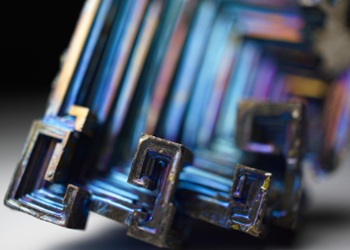
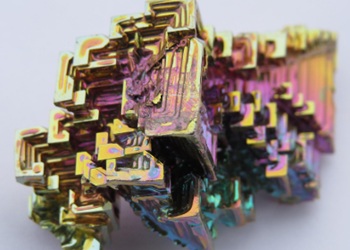
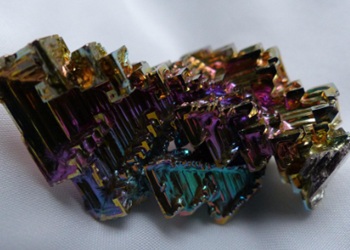
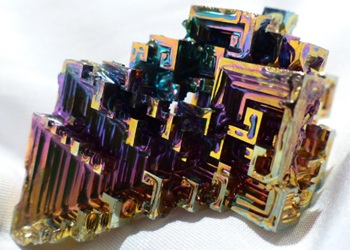
Some photos of bismuth
 |
 |
 |
 |
Bismuth is a metal on the periodic table with the atomic number 83 that’s primarily found in Australia, Bolivia, and China. It’s the most diamagnetic, or magnetically repellant, known and is also one of the least thermally conductive metals. Bismuth compounds can often be found in pigments, like the yellow-colored bismuth vanadate, and in the pharmaceutical Pepto-Bismol. It’s also proven useful in the roles that lead once filled due to their physical similarities and the fact that bismuth is, in contrast, has a notably low toxicity. It’s also slightly radioactive but, since the half life is so long, it’s still considered safe for production and consumption.
The most notable characteristics of bismuth are its iridescent color and unique, “staircase” structure. Clean bismuth is a dull silver and surface oxidation results in a slight tint. After this layer of oxidation comes under heat, thin-film interference causes light to reflect back as multiple colors. The strange patterns formed by bismuth are caused by a combination of lattice structure and varying growth rates. Bismuth grows faster at the edges of the crystal than on the faces. That combined with the fact it has a layered structure in certain conditions cause the hopper-like structure.
|
|
|
|